ezmob_search

zerads_728x90

mondiad_728x90

trafficadbar_728x90

adbytes_728x90

Search This Blog

Showing posts with label Data. Show all posts

Monday, 30 June 2025

What is 6G? Overview of 6G networks & technology


What is 6G?

6G (sixth-generation wireless) is the successor to 5G cellular technology. 6G networks will be able to use higher frequencies than 5G networks and provide substantially higher capacity and much lower latency. One of the goals of the 6G internet is to support one microsecond latency communications. This is 1,000 times faster -- or 1/1000th the latency -- than one millisecond throughput.

The 6G technology market is expected to facilitate large improvements in the areas of imaging, presence technology and location awareness. Working in conjunction with artificial intelligence (AI), the 6G computational infrastructure will be able to identify the best place for computing to occur; this includes decisions about data storage, processing and sharing.

It is important to note that 6G is not yet a functioning technology. While some vendors are investing in the next-generation wireless standard, industry specifications for 6G-enabled network products remain years away.

What are the advantages of 6G vs. 5G?

6G networks will operate by using signals at the higher end of the radio spectrum. It is too early to approximate 6G data rates, but Dr. Mahyar Shirvanimoghaddam, senior lecturer at the University of Sydney, suggested a theoretical peak data rate of 1 terabyte per second for wireless data may be possible. That estimate applies to data transmitted in short bursts across limited distances. LG, a South Korean company, unveiled this type of technology based on adaptive beamforming in 2021.

This level of capacity and latency will extend the performance of 5G applications. It will also expand the scope of capabilities to support new and innovative applications in wireless connectivity, cognition, sensing and imaging. With 6G, access points will be able to serve multiple clients simultaneously via orthogonal frequency-division multiple access.

6G's higher frequencies will enable much faster sampling rates than with 5G. They will also provide significantly better throughput and higher data rates. The use of sub-mm waves -- wavelengths less than 1 millimeter -- and frequency selectivity to determine relative electromagnetic absorption rates is expected to advance the development of wireless sensing technology.

Mobile edge computing will be built into all 6G networks, whereas it must be added to existing 5G networks. Edge and core computing will be more integrated as part of a combined communications and computation infrastructure framework by the time 6G networks are deployed. This approach will provide many potential advantages as 6G technology becomes operational. These benefits include improved access to AI capabilities and support for sophisticated mobile devices and systems.

When will 6G internet be available?

6G internet is expected to launch commercially in 2030. The technology makes greater use of the distributed radio access network (RAN) and the terahertz (THz) spectrum to increase capacity, lower latency and improve spectrum sharing.

While some early discussions have taken place to define the technology, 6G research and development (R&D) activities started in earnest in 2020. 6G will require development of advanced mobile communications technologies, such as cognitive and highly secure data networks. It will also require the expansion of spectral bandwidth that is orders of magnitude faster than 5G.

China has launched a 6G test satellite equipped with a terahertz system. Technology giants Huawei Technologies and China Global reportedly plan similar 6G satellite launches in 2021. Many of the problems associated with deploying millimeter wave radio for 5G must be resolved in time for network designers to address the challenges of 6G.

How will 6G work?

It's expected that 6G wireless sensing solutions will selectively use different frequencies to measure absorption and adjust frequencies accordingly. This method is possible because atoms and molecules emit and absorb electromagnetic radiation at characteristic frequencies, and the emission and absorption frequencies are the same for any given substance.

6G will have big implications for many government and industry approaches to public safety and critical asset protection, such as the following:

  • threat detection;
  • health monitoring;
  • feature and facial recognition;
  • decision-making in areas like law enforcement and social credit systems;
  • air quality measurements;
  • gas and toxicity sensing; and
  • sensory interfaces that feel like real life.

Improvements in these areas will also benefit smartphone and other mobile network technology, as well as emerging technologies such as smart cities, autonomous vehicles, virtual reality and augmented reality.

Do we even need 6G?

There are a number of reasons we need 6G technology. They include the following:

  • Technology convergence. The sixth generation of cellular networks will integrate previously disparate technologies, such as deep learning and big data analytics. The introduction of 5G has paved the way for much of this convergence.
  • Edge computing. The need to deploy edge computing to ensure overall throughput and low latency for ultrareliable, low-latency communications solutions is an important driver of 6G.
  • Internet of things (IoT). Another driving force is the need to support machine-to-machine communication in IoT.
  • High-performance computing (HPC). A strong relationship has been identified between 6G and HPC. While edge computing resources will handle some of the IoT and mobile technology data, much of it will require more centralized HPC resources to do the processing.

Who is working on 6G technology?

The race to 6G is drawing the attention of many industry players. Test and measurement vendor Keysight Technologies has committed to its development. Major infrastructure companies, such as Huawei, Nokia and Samsung, have signaled that they have 6G R&D in the works.

The race to reach 5G may end up looking minor when compared with the competition to see which companies and countries dominate the 6G market and its related applications and services.

The major projects underway include the following:

  • The University of Oulu in Finland has launched the 6Genesis research project to develop a 6G vision for 2030. The university has also signed a collaboration agreement with Japan's Beyond 5G Promotion Consortium to coordinate the work of the Finnish 6G Flagship research on 6G technologies.
  • South Korea's Electronics and Telecommunications Research Institute is conducting research on the terahertz frequency band for 6G. It envisions data speeds 100 times faster than 4G Long-Term Evolution (LTE) networks and five times faster than 5G networks.
  • China's Ministry of Industry and Information Technology is investing in and monitoring 6G R&D in the country.
  • The U.S. Federal Communications Commission (FCC) in 2020 opened up 6G frequency for spectrum testing for frequencies over 95 gigahertz (GHz) to 3 THz.
  • Hexa-X is a European consortium of academic and industry leaders working to advance 6G standards research. Finnish communications company Nokia is leading that project, which also includes Ericsson, a Swedish operator, and TIM in Italy.
  • Osaka University in Japan and Australia's Adelaide University researchers have developed a silicon-based microchip with a special multiplex to divide data and enable more efficient management of terahertz waves. During testing, researchers claimed the device transmitted data at 11 gigabits per second compared to 5G's theoretical limit of 10 Gbps of 5G.

Future scope of 6G networks

About 10 years ago, the phrase "Beyond 4G" (B4G) was coined to refer to the need to advance the evolution of 4G beyond the LTE standard. It was not clear what 5G might entail, and only pre-standards R&D-level prototypes were in the works at the time. The term B4G lasted for a while. It referred to what could be possible beyond 4G. Ironically, the LTE standard is still evolving, and 5G will use some aspects of it.

Similar to B4G, Beyond 5G is seen as a path to 6G technologies that will replace fifth-generation capabilities and applications. 5G's many private wireless communications implementations involving LTE, 5G and edge computing for enterprise and industrial customers have helped lay the groundwork for 6G.

Next-generation 6G wireless networks will take this one step further. They will create a web of communications providers -- many of them self-providers -- much in the way that photovoltaic solar power has brought about cogeneration within the Smart grid. 6G could advance mesh networks from concept to deployment, helping to extend coverage beyond the range of older cell towers.

Data centers are already faced with big 5G-driven changes. These include virtualization, programmable networks, edge computing and issues surrounding simultaneous support of public and private networks. For example, some business customers may want to combine on-premises RAN with hybrid on-premises and hosted computing -- for edge and core computing, respectively -- and data center-hosted core network elements for private business networks or alternative service providers.

6G radio networks will provide the communication and data gathering necessary to accumulate information. A systems approach is required for the 6G technology market that makes use of data analytics, AI and next-generation computation capabilities using HPC and quantum computing.

In addition to profound changes within RAN technology, 6G will bring changes to the core communications network fabric as many new technologies converge. Notably, AI will take center stage with 6G.

Other changes 6G is likely to bring include the following:

  • Nano-core. A so-called nano-core is expected to emerge as a common computing core that encompasses elements of HPC and AI. The nano-core does not need to be a physical network element. Instead, it could encompass a logical collection of computational resources, shared by many networks and systems.
  • Edge and core coordination. 6G networks will create substantially more data than 5G networks, and computing will evolve to include coordination between edge and core platforms. In response to those changes, data centers will have to evolve.
  • Data management. 6G capabilities in sensing, imaging and location determination will generate vast amounts of data that must be managed on behalf of the network owners, service providers and data owners.

What is a 7G network and why is it needed?

Even though 6G networks are not expected to be operational until at least 2032, research has started on seventh-generation (7G) wireless technologies. The IEEE, through its Extremely High Throughput working group, is developing the 802.11be specification for 7G and an industry certification in conjunction with the Wi-Fi Alliance.

The IEEE's amended standard is expected in May 2024. It will provide device manufacturers with design specifications to govern interoperability and performance.

6G networks are attempting to extend fast Gigabit Ethernet connectivity to commercial and consumer devices. 6G is expected to provide substantially higher throughput and data flow. As envisioned, 6G will enable the following:

  • deliver a theoretical data rate of about 11 Gbps simultaneously across multiple gigahertz channels;
  • deploy up to three 160-megahertz (MHz) bandwidth channels; and
  • multiplex up to eight spatial streams.6GE -- the "E" stands for extension -- is an interim step between 6G and 7G that will use a newly licensed 6 GHz channel that extends the available frequencies used to transmit 6G signals. The FCC in 2020 was the first regulatory body to greenlight the 6 GHz spectrum to help foster innovation of 6GE Wi-Fi devices.
  • 7G technology will represent a quantum leap in bandwidth to support ultradense workloads. For example, 7G has the potential to enable continuous global wireless connectivity via integration in satellite networks for earth imaging, telecom and navigation. Enterprises could implement 7G to automate manufacturing processes and support applications that require high availability, predictable latency or guaranteed quality of service.

    Compared to 6G, 7G is designed to do the following:

    • deliver data up to 46 Gbps -- more than four times the rate of 6G projection;
    • double the size of the channel to 320 MHz; and
    • afford 16 spatial streams, compared to eight in 6G.

Saturday, 25 January 2025

6G Network Technology


6G: What It Is, How It Works, When It Will Launch


6G is the sixth generation of cellular technology that promises to provide faster speeds, more efficient communication and wider network coverage than 5G. Here’s when it could arrive, how it could work and its pros and cons.
6G technology is the sixth generation of cellular technology that promises to provide diverse connectivity at microsecond speeds. Still in development, the mobile network will operate via higher radio frequencies with greater capacity and 1,000 times faster latency than 5G.

What Is 6G?

6G is the sixth generation of mobile network standards for cellular technology. Building off of 5G, 6G will operate on higher radio frequencies, providing more bandwidth and lower latency at microsecond speeds.

Even though 5G has barely made it out the gate, it’s already being outmoded by new tech’s rapid pace. As it stands, telecommunication services collect information from the network, externally run it through artificial intelligence (AI) machines and use the results to go back in and manually reconfigure the network. But with 6G, “we expect that the network should be able to make decisions on its own at every layer


What Is 6G?

6G is the sixth generation of cellular network technology that promises to further enhance wireless communications. While the 6G network will take advantage of 5G’s existing infrastructure, it differentiates itself by using ultra-high radio frequencies to carry more data at faster speeds, and it will have built-in AI with machine learning.

With 6G, users can expect to instantaneously transfer data and do away with buffering, lags and disconnections. In a similar way to how 2G gave us text messaging and 4G introduced an entire mobile app system, 6G will enhance machine-to-machine communication, creating greater interoperability in a “smart,” Internet-of-Things era.

“Faster wireless communication means not just faster video streaming or file downloads, but the potential for new applications ranging from networked vehicles, smart factories and collaborative virtual and augmented reality

Differences Between 5G and 6G

6G will expand on top of the existing wireless communication infrastructure of 5G, and it will be designed to surpass 5G technology in every way. In terms of speed, 6G is expected to deliver one terabyte (1,000 gigabytes) of data at one microsecond, while 5G delivers 20 gigabytes at 1 millisecond (1,000 microseconds) — potentially making 6G 1,000 times faster than 5G.

5G laid the groundwork for a user-centric model, providing broadband at scale and enabling the launch of IoT. It brought “hyperconnectivity,” Mishra said, “making human-to-machine communication possible.” But 6G’s technology will shift to a service-centric approach by accelerating the tech we know now into a more integrated digital world.

With less latency and faster communication, 6G will primarily serve machine-to-machine communication — simply because it’s so fast that our brains can’t perceive the difference.

“For human consumption,”  “I don’t think 6G will change anything.”

When Is 6G Coming?

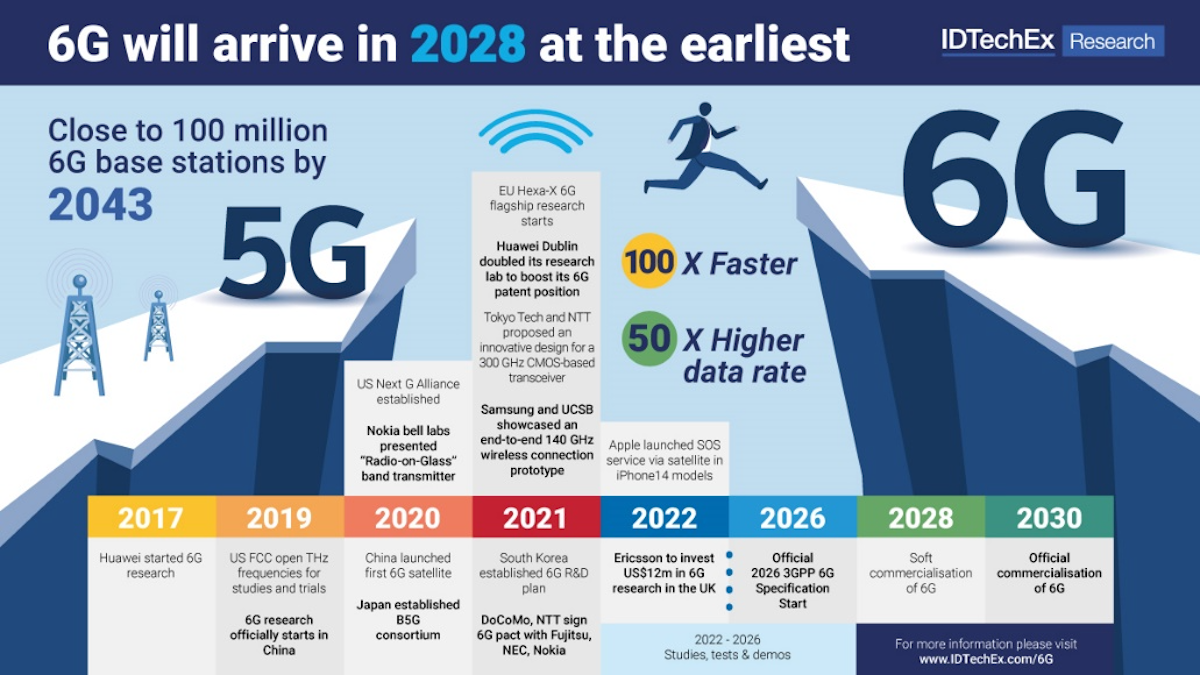
Experts expect 6G to be deployed by 2030. At the earliest, it could be 2028, according to researchers at IDTechEx.

“5G is still in its prime and, as adoption remains low, 5G carriers struggle to see a return on their investment,” Trevor Francis, CEO of telecommunications company 46 Labs, told Built In. “Lack of 5G adoption will likely push the need for 6G back even further.”


How Will 6G Work?

While the specifics of 6G are still in development, previous generations hint at how 6G could operate. Routers, antennae, base stations and other infrastructure left over from the 5G era will likely retain their roles in this new generation of cellular technology. Meanwhile, 6G networks could calculate absorption and tweak their wavelengths accordingly using different frequencies. This is made possible by two principles:  

  1. Atoms and molecules emit and absorb electromagnetic radiation at specific wavelengths.
  2. For any material, the emission and absorption frequencies are the same.  

As a result, 6G could unlock a broader range of spectrum, make wireless communication even more efficient and produce wider network coverage on devices. This could lead to future applications that improve public safety, enable health monitoring systems and advance facial recognition technology.


Who Is Working on 6G?

Governments, telecommunications providers, infrastructure companies, academic institutions and industry leaders are all currently developing tech for 6G networks.

For instance, South Korea’s Electronics and Telecommunications Research Institute is working on terahertz frequency bands for faster speeds. Also, Japan’s Osaka University has teamed with Australia’s Adelaide University to develop a silicon-based microchip, so-called a multiplexer, that is used to split and join frequencies for easier transmission.

Advantages of 6G

New Spectrum Bands

Each new generation of mobile networks features a new spectrum of radio waves. In a section known as the mid-bands, 6G will be introducing a range that spans from 7 to 20 gigahertz, improving on 5G’s 24-to-40 gigahertz. “The lower the frequency bands are, the wider the area that can be covered,” 

Low Latency, Faster Speeds

Latency, or the time it takes for a signal to bounce back round trip, will drop to the microsecond with 6G. Comparatively, users today typically experience a millisecond delay. Although this is a 1,000 times faster speed, it’s insignificant to the human eye. Reliability and overall functionality from real-time applications will become seamless. 

Seamless Connectivity

As one of the key features to come out of a 6G network, machine-to-machine communication is anticipated to streamline significantly. AI would not only be built into the framework, but also capable of handling AI-enhanced tech. The network will better integrate and advance the Internet-of-Things ecosystem, deep learning, cloud data centers and mobile edge computing. Its infrastructure would be able to support 10 million devices per square kilometer, topping 4G’s 100,000 per square kilometer. 

Unlimited Accessibility

The 6G wireless network will be able to merge aerial, ground, sea and even space communications onto one platform. Operating on a new radio spectrum enables users to interact with devices that hold low data rates, such as biosensors and IoT devices, as well as those on the high end, like a cellphone mid-flight or en-route a bullet train.

“The future involves connectivity like we’ve never seen before — connected devices, smart cities and autonomous vehicles all process significant amounts of data,” Francis said. “To enjoy the internet speeds we’ve become accustomed to, and better, requires a higher frequency.”

Disadvantages of 6G

Expensive to Build

To get 6G up and running, a new infrastructure will need to be deployed at scale, and that’s expensive. Designing new hardware that combines AI, nodes, edge computing and cloud data systems into new towers and antennae is the challenge. The good news is that many components, like physical layers and media access control, can be virtualized, so it’s only a matter of a software overhaul.

“To justify such a massive investment, 6G will most certainly need ‘killer apps’ that truly benefit from a quantum leap in wireless speeds and performance to be identified,” Kumar said. “However, if past history is any indication, the jump from 3G to 4G, for example, led to transformative new applications, ranging from video streaming and mobile gaming to ride-hailing apps.” 

Vulnerable to Security Breaches

The size of 6G’s attack surface will inevitably increase, thanks to IoT, virtualized networks and open-source technology. This means that unauthorized users have more points of entry to potentially breach than before. Consider Deloitte’s report, finding that there are 21 connected devices in a United States’ household on average.

Research suggests that data processing, threat detection, traffic analysis and data encryption top the list of critical concerns for 6G networks. High mobility requires interconnected networks; however, the more centralized a system is, the more prone to security threats it becomes. Fortified hardware, predictive capabilities of AI and machine learning, blockchain and quantum encryption are being entertained as possible security solutions.


Do We Need 6G?

6G may end up being a game-changer for developing technologies. Self-driving cars, smart cities and virtual and augmented reality could become more sustainable with 6G’s ability to connect devices through AI and machine learning. 6G also promises to bring together different types of technology, like deep learning and big data analytics, creating more possibilities for harnessing large amounts of data. 

Another reason 6G holds so much promise is its relationship with high-performance computing (HPC). The link between these two technologies could supplement edge computing and help process the large volumes of data traveling between IoT devices. 

Of course, the impact of 6G depends on what role these other emerging technologies play in society. For the time being, 6G offers a future where these technologies seem more practical than ever, thanks to more powerful high-speed connections.

Why Do We Need 6G and What Are the Challenges?

6G, compared to its predecessor, is expected to offer significantly better communication capabilities, such as Tbps-level peak data rates, microsecond-level latency, and 99.99999% network dependability.
 
Although 6G promises a lot, it is unlikely that 6G will be in daily life soon, despite the fact that several important companies and nations have already begun 6G research, as shown in the figure below, the telecom industry needs to address several issues before seeing the success of 6G. The difficulties are not only in THz technology but also in identifying applications that will fuel 6G adoption. IDTechEx has been researching 5G and 6G for years. This article will discuss some of the hardware-related hurdles to 6G connectivity, as well as potential applications that could drive 6G.


Challenges in THz Technology
 
6G will use a spectrum above 100 GHz and will ultimately reach THz. The advantages of employing such a high frequency are obvious: huge bandwidth may be used, allowing for Tbps peak data flow with microsecond-level latency. However, there are several limitations to employing such a high-frequency spectrum.
 
One of the most significant challenges ahead is that the THz signal attenuates considerably in the air, restricting the transmission range and making it easily blocked by obstructions. Because the laws of physics cannot be ignored, the most crucial element for creating a device for high-frequency communication is to provide enough energy to achieve a reasonable transmission range, even as part of an antenna array.
 
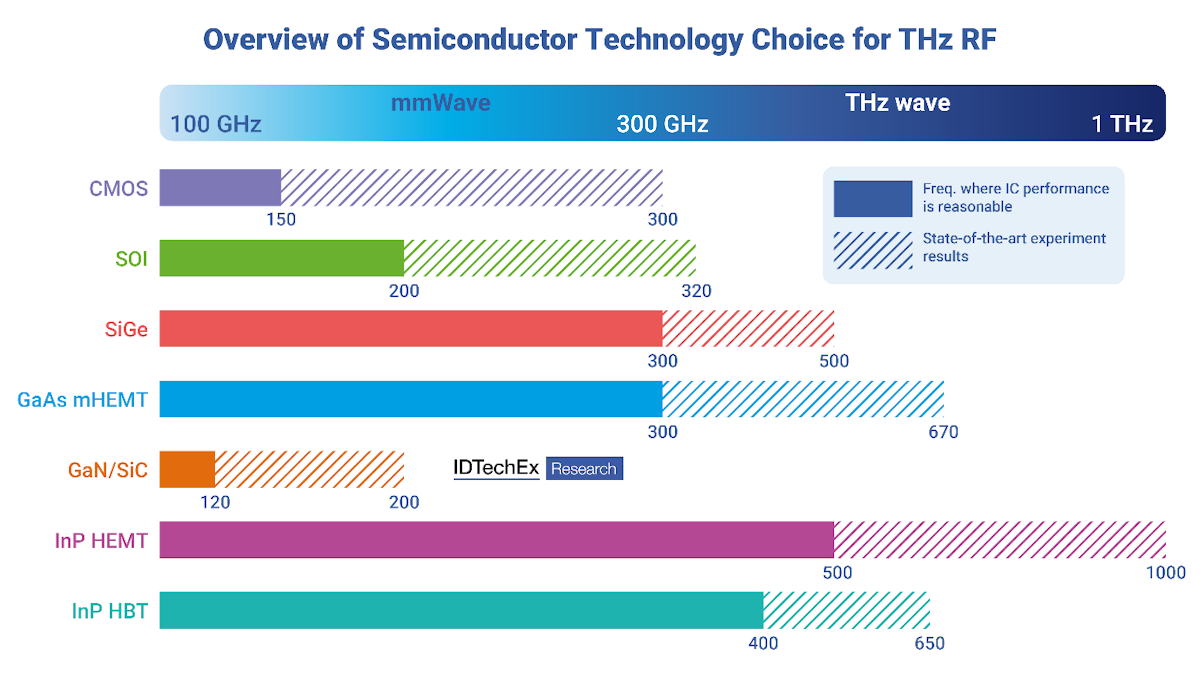
Choosing the right semiconductors to increase link range is the most critical. Below is an overview of semiconductor technology choices operating above the 100 GHz spectrum. CMOS can cover devices operating below 150 GHz, especially for short-range communication requirement devices (For longer range, using other semiconductors such as SiGe or III-V for power amplifiers may still be required). When it comes to frequencies above 200 GHz, however, a combination of CMOS for logic and III-V transistors for low-noise amplifiers and power amplifiers will be the way to go. SiGe BiCMOS technology currently provides the best compromise in terms of performance, low cost, and simplicity of integration for frequencies ranging from 200 GHz to 500 GHz. InP could be the ultimate THz technology and may be suitable in applications where cost is not the primary concern.
 
 
Other active research and development areas aside from semiconductor technologies include the need to find ultra-low-loss materials with a low dielectric constant and tan loss to avoid significant transmission loss, develop a novel packaging methodology that tightly integrates the RF components with antennas, and manage power and thermal issues as devices become more compact and complex. 
 
Applications That Could Fuel 6G Adoption
 
It is essential to identify key business use cases to stimulate the uptake of new technologies. Despite carriers' touting the superior performance that 5G mmWave provides, the mmWave market has yet to take off despite years of 5G's commercialization. The vast majority of 5G build-outs continue to use 5G sub-6 GHz. The reasons? The one reason that most people mention, according to IDTechEx's primary interviews, is the absence of applications that can be only enabled by mmWave and no other technologies. The same question about 6G will be asked: why is it needed?
 
From a consumer's perspective, having a Tbps data link and microsecond level latency but paying a higher subscription fee will probably not be attractive if the applications on their mobile devices are pretty much the same as what they have right now. We've heard a lot about hypes going on metaverse enabling by 5G and 6G, yet, the real-life use cases that can drive widespread adoption are still lacking. However, it should not be forgotten that 6G will have its unique capability in sensing, imaging, precise positioning, and so on. These characteristics will open other business use cases and enable 6G to be used in areas beyond mobile communication, which can further drive advanced digitalization and automation of various industries. For example, using 6G networks to achieve accurate perception and centimeter-level positioning of mobile robots, demonstrating the ability to remotely control mobile robots to pick up and carry various objects. At the same time, this transmission link also carries the high-speed wireless transmission of real-time high-definition video between the mobile robot and the controller, enabling synaesthesia integration. Furthermore, as the spectrum expands beyond 275 GHz, interesting use cases worth highlighting include the use of THz connections as wireless links to replace fiber for data centers, enabling reconfigurable routes and allowing the reduction of the size of server/router racks, and of course, significant cost reduction; and creating one or multiple point-to-point high-speed communication links within a device, enabling faster routing.
 
To summarize, the strong business cases IDTechEx sees for 6G are presently centered on business-to-business use cases. However, this is not to suggest that 6G will not be essential in consumer communication markets; rather, a compelling use case must be demonstrated in order to promote widespread adoption in consumer markets.
 
For more details on the technological challenges, research trends, applications, and market of 6G, please see the IDTechEx 6G market research report, "6G Market 2023-2043: Technology, Trends, Forecasts, Players". This report is built on IDTechEx's expertise, covering the latest 6G technology development trend, key applications, player activities, and market outlook, aiming to provide the reader a comprehensive understanding of 6G technology and market.

Features and Working of 6G Technology

5G deployment is still in its early stages, but 6G research and development is already underway. 6G is expected to be significantly faster, and have lower latency. The important features of 6G technology are as follows:

  • Terahertz (THz) frequencies: Engineers are attempting to transfer data over hundreds of gigahertz (GHz) or terahertz (THz) waves for 6G.
    • Radio waves with a wavelength of about 1 millimetre (frequency in THz) will be used in the 6G networks.
    • THz waves are much shorter than the waves used by 5G thus, they can carry more data.
  • Use of Artificial Intelligence: AI will be used to improve the performance of 6G networks by managing traffic and ensuring data delivery reliability.
  • Massive MIMO (Multiple-Input Multiple-Output): It is a data transmission and reception technology that employs a large number of antennas.
    • 6G networks can accommodate a large number of devices and connections.
    • G networks will be able to support an enormous number of devices, including billions of sensors and actuators.
  • Network slicing: 6G will enable the division of wider networks into smaller, dedicated networks.
    • This would make different types of traffic be prioritised and managed separately, such as video streaming or industrial automation.
  • Security: In order to protect sensitive data and applications, 6G networks will be highly secure by employing a variety of security measures such as encryption and authentication.
  • Ultra-reliable low latency communication (URLLC): It is a method of communication that ensures very low latency even in congested networks.
    • 5G URLLC could not fulfil all the Key Performance Indicators such as industrial automation, industrial automation, Virtual/Augmented Reality, intelligent transportation, Meta-Universe, etc.
    • 6G technology will lay the foundations for these emerging mission-critical applications for which the next generation URLLC (xURLLC) would be required to include it.
  • Integrated intelligent reflecting surfaces (IIRS): It is a new technology that can be used to reflect and amplify radio waves.
    • This can be used to improve the performance of 6G networks, particularly in areas where signal reception is poor.

Significance of 6G Technology

  • Sustainability: 6G will promote sustainability by supporting data collection and closed-loop control of numerous appliances by enabling faster and lower cost-per-bit connectivity.
  • Energy-efficient: 6G technology will be much more energy-efficient, turning off components and reducing capacity when demand is low.
  • Secure: 6G networks will be built to withstand threats such as jamming.

India and 6G Technology

India is preparing for the arrival of 6G wireless technology, with commercial deployment to be expected by 2030.

  • Patents for 6G: International organisations have granted India more than 127 patents for 6G technology.
    • This achievement has increased interest in India's technological breakthroughs, with countries such as the United States expressing a strong desire to receive India's cutting-edge 6G technology.
  • India-US Pact: India’s 6G ambitions got a further impetus after it signed a pact with the US to drive high-end research in the field at the 2023 G20 Summit.

Bharat 6G Vision

The Department of Telecommunications has established a Technology Innovation Group on 6G (TIG-6G) to create the Bharat 6G Vision, a strategy to develop 6G technology in India by 2030.

  • Objective of this vision: To create and deploy 6G network technologies that provide secure, intelligent, and pervasive connectivity, enabling people to live better lives.
  • The International Telecommunication Union (ITU), a UN body that oversees the development of telecom standards and is in charge of managing spectrum and satellite orbit resources around the world, has accepted the 6G Vision Framework.
    • India, through the Department of Telecommunications under the Ministry of Communications, has played an important role in the Framework's development.
  • Significance: Several countries see India as a promising destination for investments in the 6G technology sector, owing to the country's large market size potential for a significant return on investment, and favourable government policies.

Pillars of 6G Vision

Bharat 6G Project

To roll out 6G communication services by 2030, the government has set up a Bharat 6G project to identify and fund research and deployment of the next-generation technology.

  • Phases of 6G Project: The 6G project is proposed to be implemented in two phases:
    • First Phase (2023 to 2025): In phase one, support will be provided to explorative ideas, risky pathways, and proof-of-concept tests.
    • Second Phase (2025 to 2030): Ideas and concepts that show promise and potential for acceptance by the global peer community will be adequately supported to create implementational IPs and testbeds leading to the commercialisation of the 6G project.
  • Objectives:
    • Facilitate and finance R&D, design, and development of 6G technologies by Indian startups/companies/research organisations/universities;
    • Allow India to become a global leader in IP, products, and solutions for affordable 6G telecom solutions.
    • Utilise 6G technology as a force multiplier for India by 2030.
    • Enable an inclusive and significant improvement in the quality of life for citizens in India and around the world.
  • Apex Council: Its function is to oversee the project and focus on issues such as standardisation and identification of the 6G spectrum and to oversee the entire ecosystem for the development of 6G technology in India.

Challenges Related to 6G in India

  • Complex Technology: The complexity, stemming from a multitude of components and subsystems, may introduce challenges during the developmental and implementation phases of 6G.
  • Infrastructure: 6G requires substantial investments in infrastructure. For example, THz waves are also more difficult to transmit and receive, so 6G networks will need to use new antenna designs and signal processing techniques.
  • Security Concerns: The ultra-fast speeds and massive data volumes transmitted through 6G networks could expose them to cyber threats.

Security challenges related to 6G technology

  • Low availability of bandwidth: 6G is expected to enable a 1 Tbps data rate in which a large continuous bandwidth is required but in reality, these bandwidths are limited and split over several bands.
  • Lack of fibre connectivity: With less than 30 per cent of the country's telecom towers now linked by fibre, the networks are ill-equipped to support 6G data speeds.

Applications of 6G Technology

The potential use cases and applications of 6G networks are numerous and varied to meet the changing needs of individuals, industries, and societies.

Applications of 6G Technology

  • Healthcare: 6G with IoT devices will enable hospitals to access patients on demand and in an emergency.
    • For example, ambulances would be fully AI-enabled and connected to the other medical infrastructure which would enable Hospital-to-Home (H2H) services.
  • Agriculture: It would help create an intelligent predictive system using IoT and AI/ML approaches to anticipate yield, irrigation schedule, pesticide schedule, and crop health information.
  • Transportation/Air Mobility: For Urban Air Mobility (UAM), 6G will be necessary. 
    • These electric vertical take-offs and landing (eVTOL) aircraft for passengers would be extremely useful in cities like Mumbai and Bangalore, where peak hour traffic is one of the most difficult challenges.
  • Education: 6G could be used to transform education by allowing students to interact with virtual teachers and classmates and access high-quality educational resources from anywhere in the world.
  • Internet of Things (IoT): The high capacity and low latency of 6G will make the Internet of Things (IoT) more effective.
    • This is because the Internet of Things involves a large number of devices collecting and sharing data in real-time.
  • Space exploration: 6G could be used to enable new space exploration applications, such as real-time control of space robots and vehicles, and high-resolution imaging of distant planets and stars.

Conclusion:

6G technology holds the potential to transform our world in ways we can only begin to imagine. By delivering unprecedented levels of speed, reliability, and capacity, 6G will pave the way for a new era of innovation and connectivity.


Wednesday, 17 April 2024

Top 10 Technologies to Learn in 2024

Searching for Top Trending Technologies of 2024? We have prepared a comprehensive list of Newest Technologies that will heavily impact the tech industry.

Skills such as Artificial Intelligence, Machine Learning, Robotics, Data Science, Blockchain, Fullstack web development, and Cyber Security are in great demand, and major IT companies like Microsoft, Meta, Google, and Netflix are willing to pay a 300% raise to graduates who complete these courses.

Now, before directly jumping on to the details, let’s have a look at the names of top career paths that one can go for in 2023.

Here is a video that will explain you about these top technologies

Data Science

Data science is one of the hottest technologies in the 21st century. It uses Advanced analytics methods and scientific principles to extract important information from data for corporate decisions, strategic planning, and other purposes. Data science creates predictive models using sophisticated machine learning algorithms. It employs a variety of statistical techniques. These methods include machine learning modeling, statistical operations, data transformations, and data modeling. By 2026, the data science market is projected to reach a value of USD 322.9 billion, up from USD 95.3.9 billion in 2021. The average salary of the data scientist is around

10 LPA to 26 LPA based on experience, employer & location. so this makes it one of the top 10 technologies to learn in 2023.

Cloud Computing

In the past ten years, cloud computing has experienced one of the fastest growth rates of any technology. Everyday use of this technology is widespread, involving both businesses and individuals. This has led to the establishment of a large number of new jobs in this industry, with a variety of job roles available. A cloud engineer holds one of the most lucrative positions available in an organization.

Qualifications for becoming a cloud Engineer.

  • Extensive familiarity with the architecture of cloud applications.
  • Understanding of Amazon Web Services (AWS) or Microsoft Azure or you can go with  GCP.

A cloud engineer helps a business create its cloud architecture, define its cloud strategy, and plan for its deployment. A cloud Engineer typically earns $107,000 a year in the US and Rs 21 lakhs per annum in India.

DevOps

Emerging technologies are flourishing within the field of software development. Technology like DevOps is consistently demonstrating its importance among a wide range of technologies. Everyone has understood since DevOps built conception that it conquers a special potential and will alter business development. DevOps has become recognized as a crucial development methodology during the epidemic.

In fact, the survey predicted that the DevOps market would expand at a CAGR of 24.7% from 2019 to 2026 and reach a size of $20.01 billion. It is so abundantly obvious that the contribution of DevOps to digital transformation will result in radical transformations across numerous industries.

The average income for a DevOps Engineer ranges from 4.2 to 9 lakhs, with an average base pay of 7 lakhs, according to Glassdoor and Ambitionbox. The average salary of a software architect in India and the US is Rs 6.1 lacs and $135000 per annum respectively.

UI/UX

UI/UX is one of the most in demand technologies in the 21st century. Ui stands for user interface & UX stands for user experience. These days industries are focusing on designs that are more user-centered and have an easy navigation interface.

UI/UX designers are primarily concerned with the customers’ interaction with products. UI designers focus on making that interaction possible, and UX designers focus on making that interaction pleasant for the customers. UI and UX designers usually work in close collaboration with product designers and even clients during the initial stage of the design process.

The average salary of UI/UX designers is around 5.5 LPA and 15 LPA. so this can be one of the top 10 technologies to learn in the 21st century.

Artificial Intelligence

After seeing successful technologies like ChatGPT, Bard, & self-driving cars.   Artificial intelligence (AI) has generated a lot of noise. Artificial intelligence is one of the new trends that have been prevailing in the  IT industry for the last 5 years. Artificial Intelligence is used in image & speech recognition, Google Maps, ride-sharing apps like Uber, and many more

It is expected that AI would have a market cap of around 190 billion dollars. AI offers some of the highest incomes available today, ranging from over $1,25,000 per year (machine learning engineer) to $145,000 per year (AI architect).

Cybersecurity

After the covid pandemic, the world switched towards the remote way of working. But, with it, the possibility of cyber threats has increased significantly because people get access to the company infrastructure without much room for data or network security. Hence, in this era of digitalization, cybersecurity has become the most crucial aspect for businesses running online, to fight against the gamut of cyber criminals. Companies are always on the lookout for Cyber Security experts. According to the job openings listed on LinkedIn, there are 4000 cyber security positions available in India and 77000+ job openings are available in the USA.

The average annual salary of a Cyber Security professional in India is around ₹717,800 according to PayScale. ZipRecruiter records an average annual salary of about US$111,000 in the US for Cyber Security Specialists.

Full Stack Web Development

Full-stack web development is an evergreen technology. Even in 2023, it is still in great demand. Business organizations & startups need full-stack web developers to manage their websites. The main duties of a full-stack developer are developing and constructing APIs, making sure that applications adhere to performance and quality requirements, and implementing data security. In India, a Full-Stack Developer makes an average yearly pay of Rs. 7 lakhs, and in the US around 120,000$.

Salesforce

Nobody should have any doubts about the fact that Salesforce is the best customer relationship management (CRM) tool available. According to Forbes, Salesforce now holds a market share of more than 19% in the CRM industry. The online business journal also disclosed that Salesforce increased its revenue by over 23% in 2018, outpacing competing for CRM solutions.

The demand for Salesforce as a CRM has increased manifolds in this decade leading to a similar rise in the demand for Salesforce Professionals.

Let us discuss the salary of Salesforce Admin professionals. Now for the sake of simplicity, we will split the salary range based on experience level and skill acquired. The 3 categories are Entry level, mid-level, and senior.

  • The pay scale for entry-level is between Rs. 3,00,000 to 3,15,000.
  • Mid-level experts receive an average salary of Rs. 8,00,000 to 8,20,000, however, this might vary depending on several circumstances.
  • The Salesforce Senior Administrator makes between Rs. 14,50,000 and Rs. 17,50,000 while serving as the team’s leader.

The highly sought-after Salesforce Developer profile has once again been placed among the top 10 best-paying technical professions in the world. The annual salary range for a Salesforce Developer in India is between Rs. 5,00,000 and Rs. 25,00,000. This approximate number can differ from person to person. The compensation of a Salesforce Developer is determined by several criteria, including geography and experience, just like that of a Salesforce Administrator.

Product Management

Product management is the function in an organization responsible for the overall success of a product. It plays an extremely important role in business—and it’s undoubtedly one of the most rewarding career paths in tech today. The skills required to become a product manager are as follows :

  • A passion for data, excellent analytical abilities, and a thorough comprehension of the most important performance measures
  • Compassion and a user-first perspective
  • knowledge of the design process and user experience (UX) principles
  • familiarity with business & how technical teams are required.
  • Excellent interpersonal, teamwork, and presenting skills

The average salary of a product Manager varies from 68,000$ to 170,000$. So this can be one of the top 10 technologies to learn in 2023.

Business Analytics

Business analytics is a subset of business intelligence and a data management solution that focuses on the use of methodologies like data mining, predictive analytics, and statistical analysis to analyze data, turn it into information, spot trends, predict outcomes, and ultimately make better data-driven business decisions.

Business analysts are required to determine what is technically and financially possible for a firm. Businesses and companies are increasingly in need of business analysts. Additionally, a lot of businesses are willing to compensate analysts well, specially trained experts.

For new hires, the typical annual compensation for a business analyst is $70,660. You must be well-versed in the fundamental business framework, procedures, and technology at this level.

For seasoned workers, the average annual income for a business analyst is $83,008. You should be able to assess and quantify business frameworks at this level, as well as how they affect an organization and its clients.

Conclusion

We have now made you aware of the top career paths and discussed them in detail. Hope we helped you to make a wise choice. Now that you already know about the top ten career paths you can go for, what are you waiting for? It’s time to decide your future job role and get into its depth.

Please let us know if there is any technology that we skipped or if you want to learn more about any technology. Keep studying and improving till then and happy learning.

leadsleap

ezmob_inpage

Featured post

What should students, parents, and teachers know about AI?

AI education will help people understand the risks, limitations, and opportunities Former judge Kay Firth-Butterfield began to think about h...

multiwall_300x250

Popular Posts